How to visit the temples
Planning a trip to Siem Reap but not sure how to see the Angkor temples?
Six kilometers from Siem Reap town is the UNESCO World Heritage site of Angkor Archaeological Park.
How big is the temple complex?
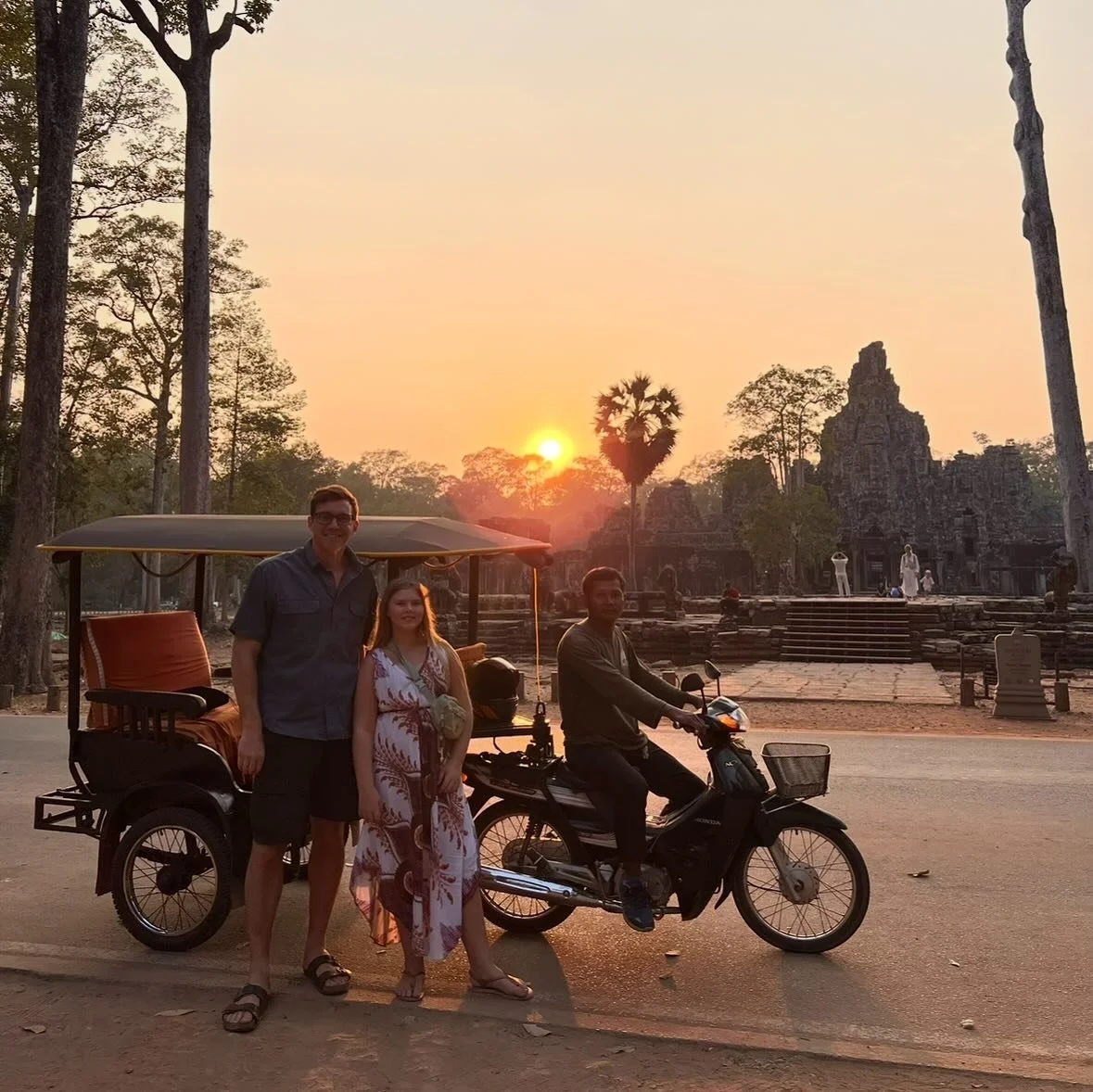
Many visitors don’t fully comprehend how expansive the Angkor Archaeological Park is until they arrive. Even when looking at an Angkor map it is impossible to properly judge the enormity of it until you are actually there. Getting around on foot in unrealistic (especially in the Cambodian heat). Instead, travelers can get from temple to temple by car, tuk-tuk, bicycle or motorbike. Tuk-tuk is by far the most popular transportation, as it gives you a nice breather in between, while you still get to take in the scenery. From Babel it should take around 20 minutes by tuk-tuk.
Where do I buy the tickets?
You'll need a pass to enter the Angkor Park. This is a personal pass, and there are 4 ways to obtain this pass:
Angkor Park Pass Ticket Counters. Your driver can take you here before you go out to the temples. You can pay with card or cash directly at the counter. You will get the pass on a paper that you will need to take good care of. The ticket office is open each day from 4.30 am to 5.30 pm.
Use our QR-code at the reception that will take you directly to the official website: https://angkorenterprise.gov.kh/
Here you will get your ticket on your smart phone. Take a screenshot of the pass to make sure you have it available even without an internet connection.
Download the APP. This app is available for both android and apple.
The app is called “Angkor Pass”.
On the ground floor of Heritage Walk shopping mall there are machines where you can get your 1-day pass ONLY.
Official prices for Angkor Pass (2026)
1-Day Pass: $37
3-Day Pass: $62
7-Day Pass: $72
There are no 2-day passes. A 3-day pass can be used within 1 week, and the 7-day pass within 1 month.
Kids under 12 years old are free. Please bring a photo of your child’s passport to prove your child’s age.
Bringing the little ones? Check out our complete Angkor Wat with Kids Guide for specialized tips on baby-carrying, shade, and keeping them engaged.
Which temples should I visit?
The three most well-known temples are Angkor Wat, Ta Prohm and Bayon. However, the area is home to more than 1,000 temples and many of the less known temples are absolutely worth exploring. The Small tour/Small circuit includes these 3 main temples. There is also a big tour/Big circuit - this does not include the main 3 temples, but some very beautiful, more secluded and less visited temples in the temple complex. We also offer the Full day Angkor Tour which includes both the small and the big tour. It is well worth doing this if you only have one day, and want to see as much as possible.
The Angkor Pass ticket covers Angkor Wat and all the temples in the Angkor Archeological Park. This means it also includes the outlying temples Beng Mealea, Chau Srei Vibol, Kbal Spean and Banteay Srei.
If you wish to only visit some of the more remote temples, and not get an Angkor pass, you can. A visit to only Beng Mealea is 10.00 USD, Kbal Spean is 5.00 USD. Tickets available at the temple (bring cash).
To visit Banteay Srei temple you need to purchase a full Angkor Pass ticket.
Where can we watch the sunset?
The most popular sunset spot is on top of Bakheng Temple. Bakheng Temple is 1.5 km northwest of Angkor Wat, and its elevated position gives visitors panoramic views of the whole area, including the legendary Angkor Wat. It can get crowded during the peak tourist season.
A great alternative is inside Angkor Wat - its stunning in the golden light.
One of our absolute favorites is the bridge over the moat to Angkor Thom, by the West Gate or South Gate.
Pre Rup Temple is a pyramid-style temple where you can climb up and watch the sunset over the surrounding jungle.
Watching the sun setting over Sra Srang lake is a beautiful alternative.
Phnom Krom temple is also starting to gain some popularity. This temple is situated on top of a small mountain, overlooking the Tonle Sap river.

Official Temple Opening Hours (Updated for 2026)
Angkor Wat
Open: 5:00 AM
Close: 6:00 PM (Main temple tower closes at 5:00PM)
Late Exit: Visitors already inside the temple at 6:00 PM are generally permitted to stay until 6:30 PM to finish their tour and exit the grounds.
Sunset Temples (Phnom Bakheng & Pre Rup) These temples are famous for their elevated views and have the longest opening hours to accommodate sunset seekers.
Open: 5:00 AM
Close: 7:00 PM
Late Exit: You can remain on-site until 7:30 PM to enjoy the full twilight colors.
Note: For Phnom Bakheng, we recommend arriving by 4:00 PM to secure a spot, as there is a limit of 300 people allowed on the top level.
Phnom Krom
Open: 6:00 AM
Close: 7:00 PM
This is a great spot to avoid the massive Bakheng crowds while still seeing a beautiful sunset over the Tonle Sap Lake.
All Other Temples (Bayon, Ta Prohm, etc.)
Open: 7:30 AM
Close: 5:30 PM
While the park gates open earlier, the "inner" gates for most smaller temples officially open at 7:30 AM.
Babel Insider tip:
The Ticket Office: Opens at 4:30 AM. If you don’t have your pass yet, you’ll need to be at the ticket office by this time to make it to Angkor Wat for the 5:00 AM gate opening.
The "Sunset Trick": If you purchase an Angkor Pass after 4:45 PM, or select tomorrow’s date online, you can enter the park that same evening for free to watch the sunset. Your ticket’s official validity won't start until the following day!
Dress code:
There is a strict dress code enforced by the Cambodian authorities to show respect for these sacred sites:
Tops: Must cover shoulders. No crop tops.
Bottoms: Must cover knees. This applies to both genders.
They are very strict with this dress code if you enter the peak of Angkor Wat.
Thoughts before you go:
How many days should I buy the pass for?
Do you want to go for sunrise/sunset?
Do you want a guide with you
Facts:
The cost for the tuk-tuk is for the entire tuk-tuk, not per person. A tuk-tuk can comfortably seat 4 adults. It is not allowed to be more than 4 adults in one tuk-tuk inside the temple complex.
Your tuk-tuk driver will wait for you. He will show you where he will be parked, outside of each temple you visit. You decide yourself how long you want to spend in each temple. Waiting is a part of their job.
The temple ticket is a separate cost.
The Updated Dress Code & Visitor Rules Sectio
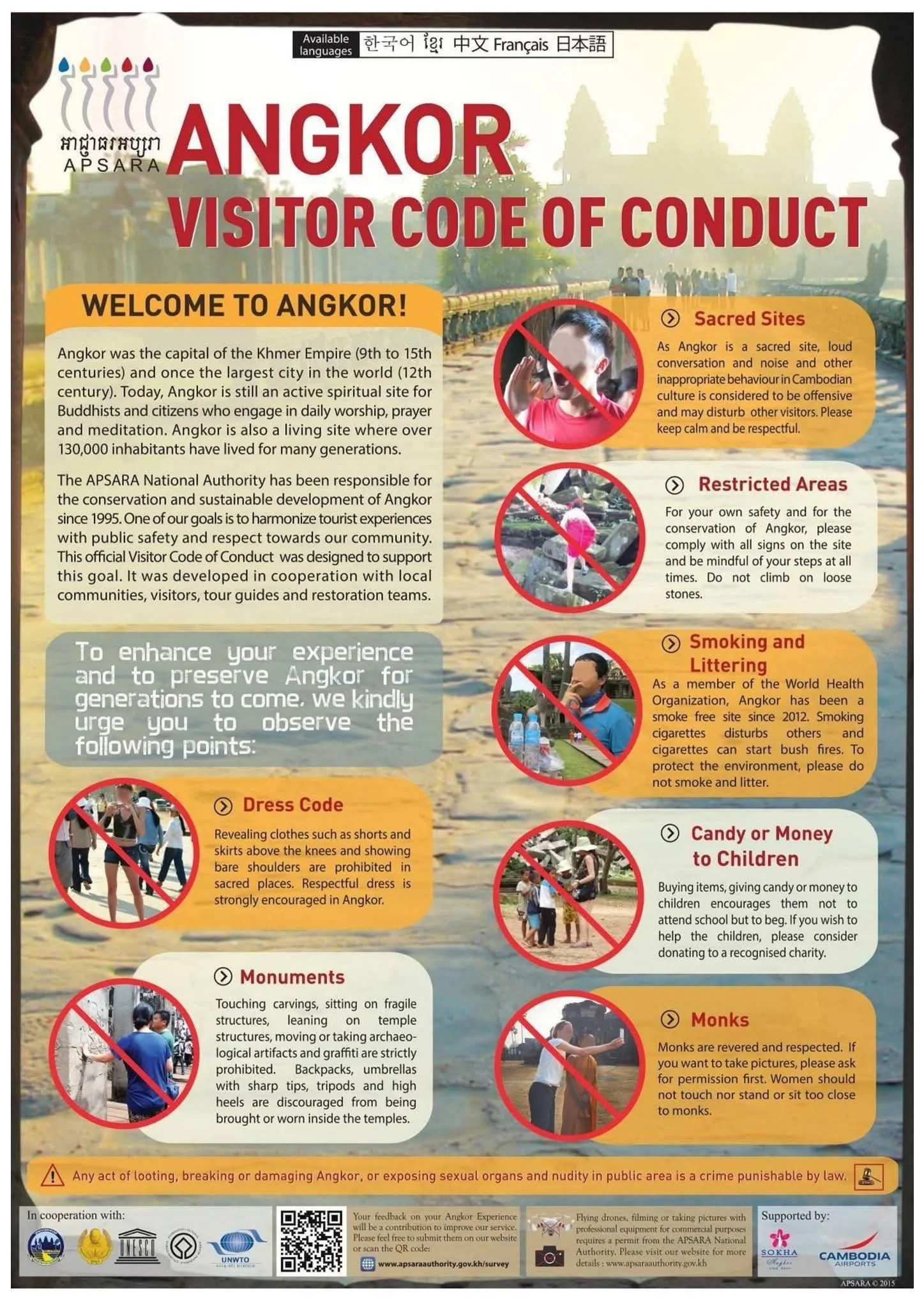
The Official Angkor Code of Conduct (Updated 2026)
Because the Angkor temples are active spiritual and sacred sites for the Cambodian people, the APSARA National Authority strictly enforces a Visitor Code of Conduct. To ensure a respectful and smooth experience, please keep these official regulations in mind:
Strict Dress Code: Revealing clothes—such as shorts, skirts, or dresses above the knees, and tops showing bare shoulders—are strictly prohibited inside the sacred areas. Wrapping a scarf or sarong over inappropriate clothing is often not accepted at the peak checkpoints (like the top tier of Angkor Wat), so please dress appropriately before leaving the hotel.
Respecting Sacred Sites & Monks: Loud conversations, shouting, or making noise is considered offensive. Monks are deeply revered; if you wish to take a photo with a monk, always ask for permission first. Women are strictly prohibited from touching monks, standing too close, or sitting near them.
Don't Give Candy or Money to Children: We kindly urge our guests never to buy items, give candy, or give money to children begging at the temples. While it is heartbreaking, doing so encourages them to skip school to beg. If you wish to help local children, please talk to us at reception about supporting recognized local charities and schools instead.
Protecting the Monuments: Touching carvings, sitting on fragile structures, leaning on temple walls, or moving archeological artifacts is strictly forbidden. Please stay on the designated paths and do not climb on loose stones.
No Smoking or Littering: Angkor Park has been a smoke-free site since 2012. Smoking disturbs others and poses a severe risk of bushfires among the jungle roots. Please carry a small bag for your trash and keep the park clean.
Restricted Gear: Backpacks, large umbrellas with sharp tips, tripods, and high heels are discouraged from being brought inside the inner temple grounds to protect the stone carvings.
Drones and professional filming equipment are strictly prohibited without a prior official permit from the APSARA National Authority.